

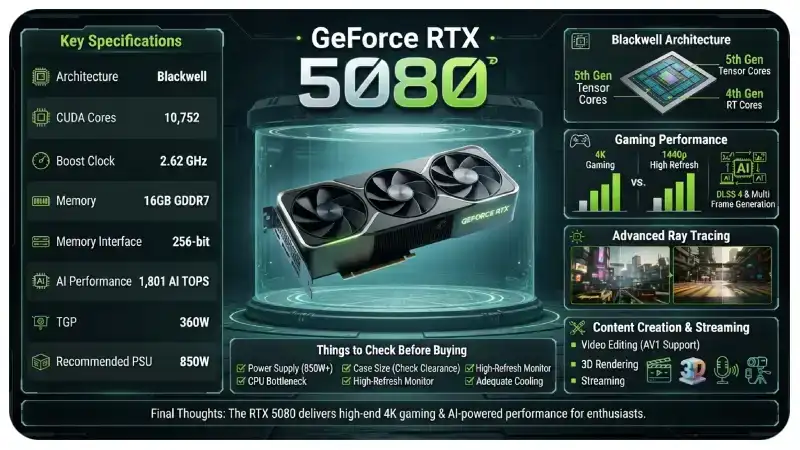
If you are building a powerful gaming PC, the GeForce RTX 5080 is a graphics card worth knowing about. It targets gamers who want strong 4K performance, better ray tracing, and access to NVIDIA’s latest AI-powered graphics features.
The GeForce RTX 5080 uses NVIDIA’s Blackwell architecture and comes with 16GB of GDDR7 memory. It also supports DLSS 4, Multi Frame Generation, and advanced ray tracing. These features make it useful not only for gaming but also for video editing, 3D work, streaming, and other demanding applications.
But specifications alone do not tell the whole story. Let’s look at what this GPU offers and what you should know before buying one.
GeForce RTX 5080 Specifications
The RTX 5080 has 10,752 CUDA cores and a boost clock of up to 2.62 GHz. It uses a 256-bit memory interface with 16GB of GDDR7 memory.
Here are the main specifications:
| Feature | Details |
|---|---|
| Architecture | Blackwell |
| CUDA Cores | 10,752 |
| Base Clock | 2.30 GHz |
| Boost Clock | 2.62 GHz |
| Memory | 16GB GDDR7 |
| Memory Interface | 256-bit |
| Tensor Cores | 5th Generation |
| Ray Tracing Cores | 4th Generation |
| AI Performance | 1,801 AI TOPS |
| Total Graphics Power | 360W |
| Recommended System Power | 850W |
| Interface | PCIe Gen 5 |
| NVENC | 2x 9th Generation |
| NVDEC | 2x 6th Generation |
These are NVIDIA’s published specifications for the reference design. Specs can differ slightly between models from different graphics card manufacturers.
Blackwell Architecture
One of the biggest changes with the RTX 5080 is its Blackwell architecture.
NVIDIA designed Blackwell around both traditional graphics and modern AI workloads. That matters because today’s games use more advanced lighting, reflections, textures, and rendering techniques than older titles.
The GPU includes fifth-generation Tensor Cores and fourth-generation Ray Tracing Cores. Together, these technologies help the card handle AI-based rendering and demanding lighting effects.
For everyday gaming, you do not need to understand every part of the architecture. The practical benefit is simple: the card is designed to handle modern games and graphics workloads without relying only on traditional rendering power.
Gaming Performance
The RTX 5080 is aimed at high-end gaming, especially at 1440p and 4K resolutions.
At 4K, the GPU has to process a huge amount of visual information. High-resolution textures, detailed environments, realistic lighting, and ray-traced effects can all increase the workload.
This is where NVIDIA’s software features become important.
DLSS can render a game internally at a lower resolution and then use AI to produce a sharper final image. When a game supports the technology properly, this can help improve performance without making the picture look noticeably worse.
Your actual frame rate will still depend on the game, graphics settings, CPU, drivers, and other parts of your PC. No GPU performs exactly the same way in every game.
16GB GDDR7 Memory
The RTX 5080 comes with 16GB of GDDR7 memory and a 256-bit memory interface. GDDR7 is a newer memory technology designed for high-speed graphics workloads.
Why does that matter?
Modern games can use large amounts of graphics memory. High-resolution textures, ray tracing, large game worlds, and demanding visual settings can all increase VRAM usage.
The 16GB capacity also gives the card room for demanding gaming and creative applications. However, memory needs vary by workload. Someone playing standard 1440p games may have very different requirements from a professional working with large 3D scenes or high-resolution video.
DLSS 4 and Multi Frame Generation
DLSS 4 is one of the major features associated with the RTX 5080.
Instead of making the GPU render every final frame entirely through traditional methods, DLSS uses AI techniques to help create the final image. Supported games can also use Frame Generation and Multi Frame Generation.
Multi Frame Generation can create additional frames between traditionally rendered frames. This can make supported games appear much smoother.
There is an important point to remember, though. Generated frames are not the same thing as increasing the GPU’s underlying rendering power. Your base performance, CPU performance, latency, and game support still matter.
NVIDIA lists DLSS 4, Frame Generation, and Multi Frame Generation among the RTX 5080’s supported technologies.
Ray Tracing
Ray tracing changes the way certain lighting effects are produced in games.
Instead of using simpler lighting techniques, ray tracing can simulate how light interacts with objects and surfaces. This can improve reflections, shadows, and other visual details.
The RTX 5080 includes fourth-generation Ray Tracing Cores. NVIDIA rates the card at 171 RT TFLOPS.
The difference can be especially noticeable in games with advanced ray tracing modes. However, enabling these settings can also increase the workload on the GPU.
That is why technologies such as DLSS can be useful when playing with demanding visual effects enabled.
Content Creation and Streaming
The RTX 5080 is not limited to gaming.
Creators can use a powerful GPU for video editing, 3D rendering, animation, streaming, and other GPU-accelerated tasks.
The card includes two ninth-generation NVENC encoders and two sixth-generation NVDEC decoders. It also supports AV1 encoding and decoding.
For streamers, hardware encoding can help handle video workloads without putting all the pressure on the CPU.
Video editors can also benefit when their software supports GPU acceleration. The exact improvement depends on the application and the type of project.
Display Support
The RTX 5080 is designed for modern high-refresh-rate displays.
NVIDIA lists support for resolutions up to 4K at 480Hz or 8K at 165Hz with Display Stream Compression under supported configurations. The card includes three DisplayPort connections and one HDMI connection.
Of course, having a GPU that supports a high refresh rate does not mean every game will reach that frame rate.
The game, resolution, graphics settings, and CPU still determine actual performance.
Power Consumption and Size
A high-end GPU needs a suitable power supply.
NVIDIA lists the RTX 5080 at 360W total graphics power and recommends an 850W system power supply for its reference configuration. The actual power requirement can vary depending on the rest of your PC.
The reference card measures 304mm long and 137mm wide. It uses a two-slot design. Add-in-board models can have different dimensions, so always check the manufacturer’s specifications before purchasing.
Your PC case also needs enough room for airflow and power connections. A powerful GPU should not be squeezed into a case that cannot cool it properly.
Is the RTX 5080 Good for 4K Gaming?
For someone building a high-end 4K gaming PC, the RTX 5080 is designed for this type of workload.
The combination of Blackwell architecture, 16GB GDDR7 memory, ray tracing hardware, and DLSS 4 gives it several tools for handling demanding games.
That does not mean every game will run at the same frame rate. Some titles are much more demanding than others. CPU limitations can also become more noticeable at lower resolutions or very high frame rates.
A balanced system is therefore important. Pairing a high-end GPU with a suitable CPU, fast storage, enough system memory, and a capable power supply can help you get the most from the hardware.
Things to Check Before Buying
Before purchasing an RTX 5080, take a few minutes to check your complete PC.
Power supply: NVIDIA recommends an 850W system power supply for its reference configuration.
Case size: Measure the available GPU space. Different RTX 5080 models may have different dimensions.
CPU: A weaker processor can limit performance in some games, particularly when targeting very high frame rates.
Monitor: A high-end GPU makes more sense when your display can take advantage of higher resolution or refresh rates.
Cooling: Make sure your case has adequate airflow. High-performance components need a sensible cooling setup.
Who Is the RTX 5080 For?
The RTX 5080 is aimed at people who want a powerful graphics card for demanding workloads.
It can make sense for users interested in:
- 4K gaming
- High-refresh-rate gaming
- Ray-traced graphics
- Video editing
- 3D rendering
- Game streaming
- AI-assisted applications
- GPU-accelerated creative software
If you mainly play simple games at 1080p, however, you may not need this level of graphics hardware. Your choice should match your games, monitor, and overall PC setup.
Final Thoughts
The GeForce RTX 5080 brings together Blackwell architecture, 16GB of GDDR7 memory, advanced ray tracing, DLSS 4, and modern video features. NVIDIA positions it as a high-end GPU for both gamers and creators.
The key is to look at the entire system rather than the graphics card alone. Check your power supply, case space, CPU, cooling, and monitor before making a purchase.
For users who want a modern high-end GPU with strong 4K capabilities and current AI-powered graphics features, the RTX 5080 provides a feature-rich platform for gaming and creative work.










Leave a Reply