

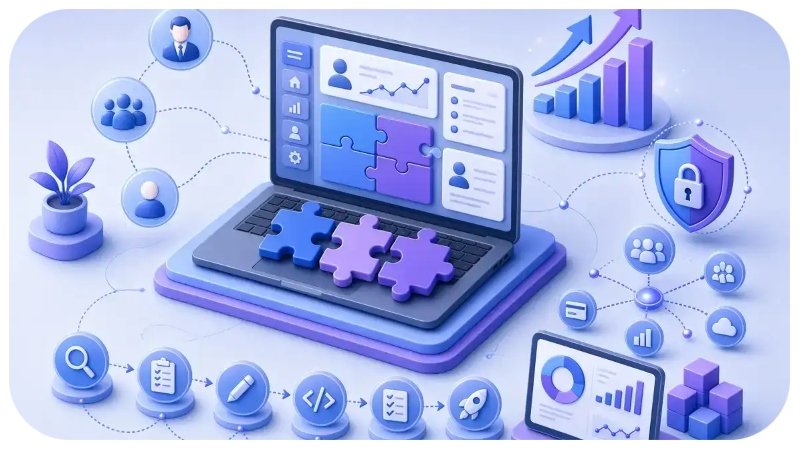
Technology now plays a major role in how businesses manage their everyday work. From handling customer information to processing payments, the right software can improve efficiency, save valuable time, and help prevent expensive errors.
Custom software development gives businesses a way to build digital tools around their specific needs instead of forcing their teams to work with a one-size-fits-all solution. With the right approach, custom software development can improve productivity, support growth, and create a smoother experience for employees and customers.
But developing custom software involves more than writing code. Businesses need to understand the development process, expected costs, important features, security requirements, and long-term maintenance. This guide explains what you need to know before investing in a custom software solution.
What Is Custom Software Development?
Custom software development is the process of designing and building software specifically for a business, organization, or particular group of users. Unlike off-the-shelf software, which offers the same basic features to many customers, custom software focuses on the unique goals and workflows of one organization.
A company might need a custom customer relationship management system, inventory platform, booking application, employee portal, financial dashboard, or mobile app. Developers can build the system around the company’s existing processes and future plans.
Building software is about more than making an application function properly. A successful solution should address a specific business challenge, simplify everyday tasks, and deliver practical value to the people who use it.
Why Do Businesses Choose Custom Software Development?
Many businesses start with ready-made software because it is affordable and quick to launch.However, off-the-shelf tools can become restrictive as a business grows and its needs change. A company may need features that the software does not offer, integrations that are unavailable, or workflows that do not match its operations.
This is where custom software development can make a real difference for a business.
1. Software Built Around Your Needs
Custom software can match the way your business operates. Developers can create specific features instead of asking employees to change their workflow to fit an existing application.
For example, a logistics company may need a system that combines delivery tracking, driver information, customer notifications, and payment records in one dashboard.
2. Better Scalability
Businesses change over time. A small company may have only a few employees and customers today but could grow significantly in the future.
A tailor-made system can grow alongside a business, making it easier to handle more users, larger amounts of data, new integrations, and additional features over time.
3. Improved Productivity
Poorly designed workflows often force employees to switch between several applications. This can waste time and increase the chance of errors.
A well-designed system can bring important tasks together. Employees may spend less time entering information manually and more time focusing on valuable work.
4. Greater Control
With custom software, the business has greater control over features, workflows, integrations, and future improvements.
Instead of waiting for a software vendor to add a requested feature, the business can work with its development team to prioritize changes based on its own requirements.
Key Features of Custom Software Development
The features a software solution needs will vary based on the company’s goals, workflow, and specific requirements. However, several capabilities commonly appear in successful software projects.
User-Friendly Interfaces
Even advanced software should have a simple and user-friendly design. Clear navigation, simple menus, readable dashboards, and logical workflows can help employees learn the system faster.
User Management
Many business applications need different access levels. An administrator may have full control, while employees, customers, or managers may only access specific areas.
Role-based permissions can help protect sensitive information.
Third-Party Integrations
Businesses often use multiple digital services. Custom software can connect with payment processors, accounting platforms, email systems, customer databases, shipping services, analytics tools, and other applications.
Good integrations reduce duplicate data entry and improve workflow efficiency.
Reporting and Analytics
Good business decisions depend on reliable data. A well-designed custom dashboard can bring key numbers, sales results, performance trends, and operational insights into one easy-to-understand view. This helps managers quickly see what is working, identify problems, and make informed decisions.
Security Features
Security needs to be considered from the very start of software development, not added later as an afterthought. Depending on the application, important measures may include authentication, authorization, encryption, secure data storage, backups, monitoring, and regular updates.
The Custom Software Development Process
A successful software project normally follows several stages. Every step helps the team avoid potential problems and ensures the software stays focused on the company’s goals
1. Discovery and Planning
The first stage involves understanding the problem.
The development team discusses the company’s goals, target users, current workflow, required features, technical requirements, budget, and expected timeline.
At this point, businesses should avoid focusing only on features. They should also clearly define the specific challenges the software is expected to address.
2. Requirements Gathering
Developers and stakeholders create a detailed list of requirements. These requirements may cover functionality, user roles, integrations, security, performance, and design.
Clear requirements help prevent misunderstandings later in the project.
3. UI and UX Design
Designers create the visual structure and user experience of the application.
They may develop wireframes and prototypes before developers begin full implementation. Testing the basic design early can reveal usability problems before they become expensive to fix.
4. Development
Developers then build the software based on the approved requirements and design.
Larger projects often use smaller development cycles. Teams can build, test, review, and improve individual features instead of waiting until the entire application is complete.
5. Testing
Testing checks whether the application works as expected.
Teams may test functionality, performance, security, compatibility, usability, and integrations. Finding problems before launch can reduce disruption for users.
6. Deployment
Once the software meets the required standards, the team prepares it for launch.
Deployment may involve configuring servers, databases, domains, security settings, mobile app stores, or cloud infrastructure, depending on the project.
7. Maintenance and Improvement
Software development does not end when an application launches.
Businesses may need security updates, performance improvements, bug fixes, new features, and compatibility updates. Regular maintenance keeps the software reliable as technology and business requirements change.
What Is the Cost of Custom Software Development?
The price of a custom software project can differ greatly depending on its size, features, complexity, and specific business requirements.
is no single price that applies to every business.
A simple internal application may cost much less than a large enterprise platform with multiple integrations and complex security requirements.
Several factors influence the total cost:
- Number of features
- Software complexity
- Design requirements
- Number of users
- Web, mobile, or both
- Third-party integrations
- Security requirements
- Development team location
- Technology stack
- Testing requirements
- Ongoing maintenance
The best way to estimate the cost is to define the project’s requirements first. A development company can then provide a more realistic estimate based on the scope.
Businesses should also consider long-term costs. Hosting, maintenance, security updates, technical support, and future development can all become part of the software’s total cost of ownership.
Custom Software vs. Off-the-Shelf Software
Both options can make sense depending on the business.
Off-the-shelf software usually provides a faster starting point. It may also have predictable subscription pricing and established features.
Custom software takes more planning and usually requires a larger initial investment. However, it can provide greater flexibility and control when standard tools cannot meet important business requirements.
A company should not choose custom development simply because it sounds more advanced. The decision should depend on business needs, budget, growth plans, and the limitations of existing solutions.
How to Choose a Custom Software Development Company
Choosing the right development partner can have a major effect on the project’s success.
Start by reviewing the company’s previous projects. Look for experience with applications similar to your own requirements.
Ask potential development partners about:
- Their development process
- Communication methods
- Project management approach
- Technology experience
- Security practices
- Testing procedures
- Estimated timeline
- Maintenance and support
- Ownership of source code
- Pricing structure
Do not judge a development company only by its lowest quote. A very low initial price may not include important services such as testing, documentation, security work, or post-launch support.
Clear communication matters just as much as technical expertise. Your development partner should understand your business problem and explain technical decisions in language your team can understand.
Common Mistakes to Avoid
Businesses can reduce development risks by avoiding several common mistakes.
Starting Without Clear Goals
A project without clear objectives can quickly become expensive and difficult to manage. Define the problem and desired outcome before development begins.
Adding Too Many Features
More features do not automatically create better software. Unnecessary features can increase costs and make the application harder to use.
Focus on the features that provide the most value.
Ignoring Security
Security should not become an afterthought. Build appropriate security measures into the application from the beginning.
Skipping User Testing
Developers understand how software works, but actual users may interact with it differently. Real-world testing can reveal confusing screens, inefficient workflows, and missing functionality.
Forgetting Future Maintenance
Every software product needs ongoing attention. Plan for updates, monitoring, technical support, and future improvements before launch.
Is Custom Software Development Worth It?
Custom software can be a strong investment when a business has specific requirements that existing products cannot handle effectively.
The biggest benefit comes from solving meaningful problems. If custom software saves employees time, reduces errors, improves customer service, connects disconnected systems, or creates a competitive advantage, the investment may deliver significant long-term value.
However, not every business needs a custom solution. If an existing product already meets your requirements at a reasonable price, purchasing that product may be the smarter choice.
The key is to compare the long-term value of each option rather than focusing only on the initial price.
Final Thoughts
Custom Software Development can help businesses create technology that fits their unique operations, goals, and customers. From planning and design to development, testing, deployment, and maintenance, every stage plays an important role in creating a reliable product.
The best approach starts with a clear business problem and realistic requirements. Choose useful features, prioritize security, test the product with real users, and plan for long-term maintenance. When those pieces come together, custom software can become a valuable tool for improving efficiency and supporting sustainable business growth.













Leave a Reply