

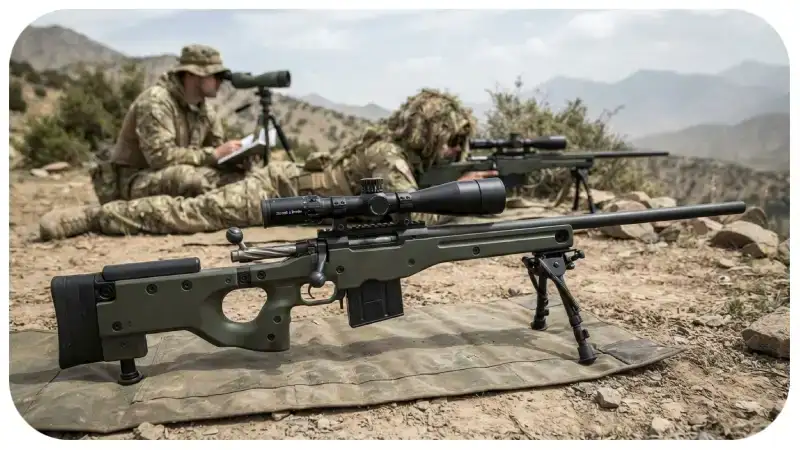
The Accuracy International AWM is a British precision rifle that gained widespread recognition for its role in military long-range shooting. Its development marked a significant step in the evolution of the Arctic Warfare rifle family, bringing a proven design into a category built around larger Magnum cartridges. Over time, the rifle became closely associated with British military service and earned recognition among military equipment enthusiasts worldwide.
The story of the Accuracy International AWM goes beyond its technical specifications. It also reflects changing military requirements, advancements in optical equipment, and the ongoing effort to balance accuracy, portability, and reliability. Its British military versions, particularly the L115 series, helped establish its place in modern military history.
This guide explores the rifle’s origins, design, major variants, specifications, international adoption, and continuing significance.
What Is the Accuracy International AWM?
The Accuracy International AWM, short for Arctic Warfare Magnum, is a bolt-action precision rifle developed by the British manufacturer Accuracy International. It belongs to the company’s Arctic Warfare family but was adapted to accommodate larger cartridges than those used by the original rifles.
The AWM is most closely associated with two cartridge types: .300 Winchester Magnum and .338 Lapua Magnum. These configurations helped distinguish it from conventional military precision rifles built around smaller cartridges.
Unlike a semiautomatic rifle, a bolt-action rifle requires the operator to cycle the bolt manually between shots. This traditional operating system remains common in precision rifles because it provides a straightforward mechanical design suited to specialized military roles.
Another defining characteristic is the AWM’s five-round detachable magazine in its standard configuration. The rifle combines this conventional operating principle with a purpose-built stock and chassis arrangement designed for demanding field conditions.
The name can sometimes cause confusion. AWM refers to the Arctic Warfare Magnum, while AWM-F identifies a folding-stock configuration. AWSM is another designation associated particularly with the .338 Lapua Magnum version. British military rifles derived from the platform also carry their own service names, including L115A1 and L115A3.
Understanding these distinctions is important because the specifications and equipment of individual rifles can vary.
History and Development of the AWM
The history of the Accuracy International AWM begins with the earlier rifles developed by Accuracy International. Founded in the United Kingdom, the company became known for precision rifle designs intended to meet demanding sporting and military requirements.
Its earlier PM and L96A1 rifles helped establish its reputation. The company subsequently developed the Arctic Warfare family, which built on that experience and became associated with military requirements for reliable performance in challenging environments.
Accuracy International describes the development of its AW family as part of a longer history of collaboration with military and government users. The company’s later contracts included Germany’s G22 and Britain’s L115A3. These programs illustrate how its rifle designs evolved to meet different service requirements.
The AWM represented a further development of the Arctic Warfare platform. Rather than designing an entirely unrelated rifle, the company adapted the established architecture for longer Magnum cartridges.
This change required more than a different ammunition choice. The action and related components had to accommodate the dimensions and operating characteristics of the selected cartridges. The result was a rifle family designed for a different class of military precision work.
As military interest in longer-range precision capabilities grew, the AWM became an important option for forces seeking a dedicated Magnum-caliber rifle.
Accuracy International AWM Specifications
The specifications of the Accuracy International AWM depend on its configuration. Figures associated with the general AWM family should not automatically be applied to every military variant.
The following table summarizes commonly reported characteristics of the rifle family.
| Specification | General information |
|---|---|
| Country of origin | United Kingdom |
| Manufacturer | Accuracy International |
| Rifle type | Bolt-action precision rifle |
| Common chamberings | .300 Winchester Magnum and .338 Lapua Magnum |
| Standard magazine capacity | Five rounds |
| Common barrel length | Approximately 686 mm on the .338 configuration |
| Stock options | Fixed or folding, depending on variant |
| Military role | Long-range precision shooting |
| Notable service designation | British L115 series |
These characteristics provide a useful overview, but individual models may differ in weight, overall length, barrel configuration, optics, and accessories.
For example, the British Army lists the L115A3 at 6.8 kilograms, with an overall length of 1,300 millimeters, a five-round box magazine, and a stated effective range of more than 1,100 meters. The Army also lists a muzzle velocity of 936 meters per second. These figures refer specifically to the L115A3 service configuration rather than every rifle carrying the AWM name. Source: British Army
The distinction matters when comparing published specifications. Military equipment pages may describe a complete service system, whereas general reference pages may list the characteristics of a particular rifle configuration.
Understanding the AWM’s Main Variants
The AWM developed into several configurations as military customers selected different combinations of ammunition, stocks, and supporting equipment.
AWM
The standard AWM is the central model in the Magnum branch of the Arctic Warfare family. It was designed around larger cartridges and retained the manual bolt-action system associated with the wider platform.
Its importance lies in the way it extended an existing design rather than replacing every element of the earlier rifle family.
AWM-F
The AWM-F is associated with a folding stock. This feature allows the rifle to be made more compact for transport, although its overall dimensions and weight depend on the particular configuration and attached equipment.
Germany’s G22 is a notable example of a military rifle based on the AWM-F configuration. German forces adopted the G22 in .300 Winchester Magnum, demonstrating that the platform was not limited to the .338 Lapua Magnum cartridge.
AWSM
AWSM stands for Arctic Warfare Super Magnum and is a designation commonly associated with the .338 Lapua Magnum version of the rifle. Usage can vary between sources, so it is helpful to consider the context in which the term appears.
British L115 Series
The British military introduced several service designations based on the AWM platform. The L115A1 was followed by the better-known L115A3, which incorporated updated equipment as part of a broader military sniper-system improvement program.
The later L115A4 represents another stage in the British platform’s development. These designations describe specific military configurations, not interchangeable names for every AWM rifle.
The Difference Between .300 Winchester Magnum and .338 Lapua Magnum
The AWM’s two principal chamberings help explain its place in military rifle development.
The .300 Winchester Magnum was originally developed as a high-performance sporting cartridge and subsequently found applications in precision shooting. Its use in military rifles demonstrates how cartridge designs developed for one purpose can also serve specialized military requirements.
The .338 Lapua Magnum was developed for demanding long-range applications and became particularly associated with military precision rifles. It offered another option for forces looking beyond traditional 7.62mm systems.
Both cartridges are part of the AWM’s identity, but their characteristics and the rifles configured for them should not be treated as identical.
This is why a statement about the range, velocity, or dimensions of one AWM configuration may not accurately describe another. Cartridge choice is only one part of the complete system; the specific rifle, barrel, ammunition, and supporting equipment also matter.
British Military Service: The L115A1 and L115A3
The United Kingdom is among the most recognizable military users of the AWM family. British forces adopted a .338 Lapua Magnum configuration under the L115 designation, giving the platform an important role in the country’s long-range precision capability.
The L115A3 became particularly well known. According to the British Army, it was introduced through the Sniper System Improvement Programme, with the first systems deployed to Afghanistan in May 2008.
Importantly, the British Army describes the system as more than a rifle. Its supporting equipment included day and night sights, spotting scopes, laser rangefinders, and tripods. This reflects the way military precision work depends on observation, identification, and information as well as the rifle itself.
The L115A3’s official specifications include a 6.8-kilogram weight, a 1,300-millimeter overall length, a five-round magazine, and a listed effective range exceeding 1,100 meters.
The L115A3’s service history illustrates how a commercial manufacturer’s rifle design can become part of a broader military capability. It also demonstrates why the rifle’s legacy cannot be understood solely by looking at its cartridge or headline performance figures.
International Military Adoption
Although the AWM originated in the United Kingdom, rifles from the wider family have served with military and specialist organizations in other countries.
Germany adopted the G22, based on the AWM-F configuration, in .300 Winchester Magnum. This example highlights the flexibility of the platform and the different choices military organizations make when selecting equipment.
The Netherlands also adopted .338 Lapua Magnum AWM-F rifles for military use. Dutch service illustrates the rifle’s association with specialist precision roles beyond its original British setting.
Other countries have been associated with AWM-family rifles, but it is important to distinguish verified AWM operators from countries that use other Accuracy International models. The company produces several rifle families, and not every rifle manufactured by Accuracy International is an AWM.
Military designations can also differ significantly from the manufacturer’s product names. As a result, reliable identification requires checking the particular model, cartridge, and service designation rather than relying on a general reference to an Accuracy International rifle.
The international history of the AWM therefore reflects both the appeal of its basic design and the importance of adapting military equipment to national requirements.
The AWM and the Development of the AXMC
The Accuracy International AWM also provides useful context for understanding the company’s later rifle designs.
The AXMC, part of the AX family, represents a subsequent development of Accuracy International’s approach to precision rifles. It was designed with a more adaptable architecture and was developed to accommodate multiple cartridge options.
The AWM’s .338 Lapua Magnum configuration had limitations related to the length of some cartridges that could be accommodated by its magazine. The later AXMC design addressed this issue through changes to the action and magazine arrangement.
This development illustrates a common pattern in military engineering. A successful design may perform its intended role well while revealing limitations as ammunition, equipment, and user requirements evolve.
Newer designs seek to address those limitations without necessarily diminishing the historical importance of earlier models. The AXMC is therefore best understood as part of the ongoing development of Accuracy International’s precision-rifle family rather than simply as evidence that the AWM lacked value.
The company’s modern rifles continue to reflect its long-standing emphasis on precision, modularity, and demanding field conditions.
Why the Accuracy International AWM Remains Significant
The Accuracy International AWM remains an important subject in discussions of modern military rifles because it helped extend the Arctic Warfare platform into the Magnum-caliber category.
Its significance rests on several connected developments. First, it adapted an established rifle architecture to larger cartridges. Second, it became associated with recognizable military service designations, particularly Britain’s L115 series. Third, its development helped illustrate the growing importance of combining a precision rifle with advanced observation and supporting equipment.
The rifle also offers a useful example of the relationship between engineering and military requirements. A weapon is not evaluated only by its headline specifications. Reliability, weight, portability, serviceability, optics, and compatibility with supporting equipment all contribute to its practical role.
The AWM’s place in military history is therefore broader than its reputation for long-range performance. It represents one stage in the evolution of precision rifles from established bolt-action platforms toward increasingly adaptable systems.
Although newer designs have developed from the same general tradition, the AWM remains recognizable because of its connection to British military service and the wider Arctic Warfare family.
Frequently Asked Questions
What does AWM stand for?
AWM stands for Arctic Warfare Magnum. It identifies a Magnum-cartridge development of Accuracy International’s Arctic Warfare rifle family.
Where is the Accuracy International AWM made?
The AWM was developed by Accuracy International, a British firearms manufacturer.
Which cartridges are associated with the AWM?
The rifle family is commonly associated with .300 Winchester Magnum and .338 Lapua Magnum configurations.
What is the British military version called?
British military versions include the L115 series, notably the L115A1 and L115A3. These designations refer to specific service configurations.
What is the difference between the AWM and AWM-F?
The AWM-F is associated with a folding-stock configuration. Other specifications depend on the particular model and equipment.
Is the AWM the same as the AXMC?
No. The AXMC is a later Accuracy International rifle design with a different architecture and multi-caliber capabilities.
Conclusion
The Accuracy International AWM occupies an important place in the history of British precision rifles. Developed from the Arctic Warfare family, it adapted an established platform for larger Magnum cartridges and became associated with military service in several countries.
Its British L115 variants helped make the rifle widely recognizable, while the German G22 and Dutch AWM-F configurations demonstrate how different military organizations adopted related designs to meet their requirements.
The AWM’s lasting importance comes from its combination of established engineering, military adaptability, and influence on the development of later precision-rifle systems. Understanding its history, variants, and service designations provides a clearer picture of why it remains a notable example of modern military rifle development.














Leave a Reply